Zhan
Critical Reflection GENDER STEREOTYPES IN CHILDHOOD
Gender is Performative
"It’s one thing to say that gender is performed and that is a little different from saying gender is performative. When we say gender is performed we usually mean that we’ve taken on a role or we’re acting in some way and that our acting or our role playing is crucial to the gender that we are and the gender that we present to the world." (Butler)
The concept of gender differentiates and defines people according to their sexual characteristics, binds people's nature, and limits their existence to their reproductive significance. Butler's performance theory states that gender is a socially-evolved concept, gender is seen as innate, and therefore gender is seen as related to sexual characteristics to protect reproductive efficiency.
"If the immutable character of sex is contested, perhaps this construct called ‘sex’ is as culturally constructed as gender; indeed, perhaps it was always already gender, with the consequence that the distinction between sex and gender turns out to be no distinction at all." (Butler, Gender trouble pg 9)
Gender identity is the internal sense we have of our own maleness or femaleness or otherness
“We act as if that being of a man or that being of a women is actually an internal reality or something that is simply true about us, a fact about us, but actually it’s a phenomenon that is being produced all the time and reproduced all the time, so to say gender is performative is to say that nobody really is a gender from the start. I know it’s controversial, but that's my claim." (Butler)
Therefore, both men and women are bound by the concept of gender: for women, they are encouraged to be reserved, euphemistic and femininity; for men, they are encouraged to be bold, courageous, and masculinity.
Gender Labeling
During children's growth, children first connect biological gender and social gender information through their observations and establish the most basic gender stereotype - "gender labeling." Then as physical growth and cognitive development, coupled with more social experiences of interacting with others in everyday life, children continue to make more inferences based on gender labels.
- Young children think/describe themselves in terms of:
Physical characteristics (sex)
Behavior (gender expression)
As the primary way of children's socialization, family and growth environment have influenced forming children's gender stereotypes. Parental and socio-cultural play a part in providing children with more social experiences. Because most parents have gender stereotypes, parents play an important position in developing gender stereotypes in their children. Mainstream media are also involved in the formation of child gender stereotypes. Most gender images displayed on TV and in books fit basic gender stereotypes.
So many young children either think of or describe themselves in terms of external cues, such as anatomy or behavior (“If I like trucks, I must be a boy”).
Take my childhood as an example. I lived in a very traditional family, growing up with my cousin under the care of my grandparents. In early childhood, my dress was determined by my family. They thought I was a girl, so most of my clothes were pink. And my cousin, I never saw him in pink or brightly colored clothes. Not only the clothes but our toys are also very different. I like dolls, and he likes Ultraman and cars. Our two preferences are very much in line with the stereotyped gender image in the public mind. Although my grandma and grandpa did not force me to like these toys and colors, in the subtle influence of life and education, under the advice of other adults, I think I should be like "all" girls, keep a nice appearance and well-behaved.
When I was a kid, our lives were defined by gender. Books and comics will intentionally divide boys and girls into two different groups. Take a well-known Chinese cartoon as an example: Xi yang yang and Hui tai lang, Mei Yangyang, the most common decent female character, had a pink scarf tied around her neck. She loves cleanliness and beautiful things and looks in the mirror every day. She is cowardly and timid, and she will only ask for help from the protagonist when encountering bad people. I like this character when I was a kid, because I think she is the girl that I want to be.
In many cartoons, the characters which representing female characters are normally pink or purple, while male characters have a much wider distribution of colors. Female characters' personalities are generally relatively simple; they are uncourageous, like beautiful things, and cannot promote too many plots. The male characters are much plump, they have a variety of hobbies and personalities, and they have more opportunities to push the conflict.


<The Blue Project - Jake and His Blue Things>
Light jet Print, 2006.
JeongMee Yoon ''the Pink and Blue Project''

<The Pink Project - SeoWoo and Her Pink Things>
Light jet Print, 2006.
This project by Yoon explores trends in cultural preferences and differences in tastes among children (and their parents) from different cultures, ethnic groups, gender socializations and identities.
“The Pink and Blue Projects were initiated by my five-year-old daughter, who loves the color pink so much that she wanted to wear only pink clothes and play with only pink toys and objects. I discovered that my daughter’s case was not unusual. In the United States, South Korea and elsewhere, most young girls love pink clothing, accessories and toys. This phenomenon is widespread among children of various ethnic groups regardless of their cultural backgrounds. Perhaps it is the influence of pervasive commercial advertisements aimed at little girls and their parents, such as the universally popular Barbie and Hello Kitty merchandise that has developed into a modern trend. Girls train subconsciously and unconsciously to wear the color pink in order to look feminine” (Yoon)
In Yoon's statement, pink was once a color associated with masculinity and was considered a light red with powers related to that color. After World War II, the United States and elsewhere started switching girls to pink and boys to blue. These color habits have become a global standard as advertising influences consumer preferences.
Differences between girls' and boys' objects are also categorized and affect their thinking and behavior patterns. Many girls' toys and books are pink, purple, or red and are related to makeup, grooming, cooking, and family affairs. However, most boys' toys and books are made of different shades of blue and are related to robotics, industry, science, dinosaurs, etc.
Yoon points out that as girls get older, their preferences for pink change. When girls grow up, they become less obsessed with pink. Usually, their flavors turn purple, which is close to pink. There may be transitions later, but the original association with the color code usually remains.
By the 1940s, marketing began to use gender divisions to get people's attention. Brainwashing marketing affects people in the big environment, making people believe that men should pick deeper and more settled colors (blue, black, grey, etc.) and women should use more bright colors. Pink is used to represent the color of blood and muscle. It was a warmer and more brilliant color than blue, which was thought to define masculinity.
Using color to divide gender seems to be prevalent in people's lives. I used to be a painting teacher in a children's art class. Because children can't master brushes and paints very well, we all provided them with aprons. The apron is available in pink and blue. The pink ones are full of bows and bears, and the blue ones are cars and planes. Although our boss did not explicitly tell us whether boys and girls should use a specific color, my colleagues always subconsciously give pink aprons to girls. The one time that impressed me the most was when a boy didn't want to wear a blue apron. He said he liked pink. A colleague of mine was deeply confused, "Why does a little boy like pink?" Because of the teacher's doubts, the boy may feel out of place with his friends, so he doesn't change his blue apron.
Grayson Perry's Claire and Alan Measles
https://corridor8.co.uk/article/making-claire-grayson-perry-walker-art-gallery/v
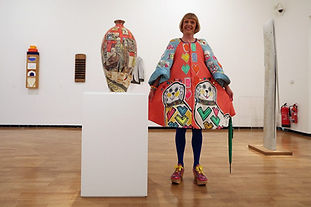

Grayson Perry (1960) is a British contemporary artist, writer and broadcaster. He is known for his ceramic objects, tapestries and cross dressing. Perry's ceramic vases frequently feature Perry as "Claire" (his female alter ego) and "Alan Measles" (his childhood teddy bear).
His vase works are like his autobiography, and the characters in them are basically from the stories of his childhood.
He is fighting against traditional male stereotypes, he wear in fancy dresses and stand beside with his vases. His works are brightly colored, with figures depicted on his clothes and pots in a childlike manner. Perry uses his own experience to explore the forms of gender, which are often incorporated into designs. "The unbridled, power-hungry masculinity of men is a scary thing." He also believes women must stop expecting men to live up to stereotypical male stereotypes. "'I'm not going to be your protector. Or serve you.' Let women do it for change. If women want fucking equality, let them be protectors and providers. That's what men have to understand The deal. Giving up control feels so foreign to us, but if you want equality, there are ups and downs" (Perry).
Perry has his way of expressing his opposition to male stereotypes. He was considered a transvestite by people in his youth because he liked to wear women's clothing. He was considered a transvestite in his youth because he wanted to wear women's clothing.
In my opinion, childhood toys represent a person's story and portrait. They accompany people to spend many unforgettable times. Everyone has their own "Alan Measles". In most of my works, my favorite dolls appear on them, they give me a sense of security, and at the same time, they also witness me becoming the human being I am now.
"Swimming pool"

I want to present my childhood memories in my project. In the work “Swimming pool," I place objects that are often present in my childhood, they have no mind or soul, but their appearance occupies my whole childhood. Plush dolls, bow ties, princess dresses, etc. Since I was born, my family gave me those toys, and they accompanied me through my childhood, I didn't have the right to choose the toys I was interested in. Like a puppet, I've been told that I like these things, and I think I do like them in this brainwashing remark. I don't know if I like them, but their company has become a habit, and my life is full of them.
Because memories are vague, I wanted to give my photos a foggy feel. My inspiration and approach to painting came from a series of oil paintings by Gerhard Richter. Richter paints very detailed works first, then slides them with a squeegee over the wet paint to make the image look hazy like an old photograph. I used the same method, first making the subject detailed, then using beeswax mixed with linseed oil and paint to tile the painting. I didn't have a squeegee, so I used a palette knife and brush instead and evenly spread the translucent beeswax over the canvas, which can give a similar feel to the work of Gerhard Richter but with a more blurred finish.
The work ultimately presents a hazy, dreamlike scene to the viewer. My childhood impression is vague, but I can remember being surrounded by dolls and pretty things. It's not a suitable place; those toys are wrapped in a puff of pink smoke. There are also some metaphors appear inside of my painting, such as the puppet in the box and the pigeon standing on the orange. It's not that I don't like them; they've been with me for a long time and left a lasting memory. But these "good friends" of mine are not chosen by me but given by family members, or because my friends all have similar items, so I ask my family to provide me with similar things. All of which are metaphors for my seemingly free childhood but full of gender stereotypes.
Can we change children's perceptions of gender through socialization? Toys, clothes, friends, stories, etc., will this change their perceived gender? Or does this change what they think it means to be a specific gender ?
It’s not clear how much external influence socialization can have on a child’s own gender identity, but there are many examples of children continuing to behave consistent with their gender identity regardless of how adults try to shape their universes.
I'm lucky that I've accepted my biological gender. Still, for those whose gender identity is different from the gender assigned at birth, those gender labels and stereotypes certainly create stress and anxiety.
Another critical issue in children’s development of gender identity is what happens when their identity is rejected. Suicide attempts are among the greatest fears with transgender children/adolescents/emerging adults whose identity is rejected by their social circle.
Extended Research (Click for more information)
This is a collaboration project with Yihong Liu
This project combined photograph and gouache painting.
Yihong Liu was invited by Chenxi Zhan to create this project together. Considering the need for a certain number of interviews and a variety of interviewees, Liu decided to conduct interviews with random passersby on the street. The interview asked respondents to answer three questions: what their gender pronouns were, whether their gender had changed, and what their favorite toy was as a child. After taking notes of those responses, Liu asked each respondent if they would like to take a photo, and asked respondents to pose in their favorite childhood photo pose (if possible). Through these steps, Liu hopes to summarize some patterns from the collected data, and show the characters of the owners of some answers through more intuitive photos.
Liu and Zhan want to have a deeper research based on different people's childhood. And how does their childhood influenced or shaped their identity.
Based on Liu's street interviews and photographic works, Zhan uses the information in Liu's interviews to draw the protagonists in the photographic works and what their childhood toys look like. This is a collaborative work that combines artists' imagination and facts.