Zhan
Critical Reflection
The connection between people and objects
In most people's lives, there will be collecting some precious item. Precious does not mean that the object is very expensive, but to the person, the object contains memories that he cherishes, the importance with those objects is irreplaceable.
Significance (charge) of objects:
For some people, objects are always given some special meaning. These objects can be people's friends, can be a container that hold people's memories, or can be a symbol that represent people.
In the book “Evocative Object, Things We Think With” by Sherry Turkle, the writer trend to tell her personal stories by introducing different objects that appeared in her life. She wrote at the beginning of the book: “We find it familiar to consider objects as useful or aesthetic, as necessities or vain indulgences. We are on less familiar ground when we consider objects as companions to our emotional lives or as provocations to thought. The notion of evocative objects brings together these two less familiar ideas, underscoring the inseparability of thought and feeling in our relationship to things. We think with the objects we love; we love the objects we think with” (Turkle, 2011,p. 5),
In Turkle’s book, there is a chapter called “Murray: The Stuffed Bunny” Turkle mentioned her personal story with her little sister Shayna and the stuffed bunny named Murray. I can feel a really close connection with Turkle’s little sister. I often named my toys and tried to communicate with them.
Turkle’s little sister Shayna seen Murray as her same age friend. They grew up and play together throughout Shayna’s childhood. Turkle traveled with Murray into Shayna’s imagination. Murray has the ability to comfort, entertain, and amaze her sister delights. This stuffed bunny can seen as a manifestation of people’s tendency to embody character inside fluff and fabric. “When Shayna is upset, I watch as Murray dries her tears, and I am sue what taken aback to discover the I, too, am comforted by his presence” (Turkle 173). “For me, Murray has any faces. As a sister, I am grateful to him for bringing me closer to Shayna. I speak for him (Always a high, squeaky voice appropriate for a small bunny) and can make my sister laugh. I hug him and treat him as a person, and my sister beams with pleasure. As a researcher, he has given ,e a ringside seat at the performance of Shayna’s imagination, even as I remind myself that in fact it was she, as his creator, who bought me the ticket to that seat” (Turkle, 2011, p. 175).
For my personal experiences, I am a big fan of plush toys, and my house is filled with dolls of all shapes and sizes. I always feel insecure; being surrounded by stuffed toys increases my sense of security. Whether from the soft touch or the cute appearance, it can calm me down. When I was young, I think every toys have a soul. I can speak to them, and they can understand what I say. When I am happy, I share my excitement with them; when I am sad, they can help me express my sadness. Many feelings in the heart are difficult to express in words, and when those emotions cannot be described in terms appear, the doll becomes a perfect friend to chat with.

Through my interviews with people, most of the people I interviewed enjoyed playing with stuffed animals as children. When people grow up and become more nostalgic, they always collect things that are similar to the toys they played with before. Toys play an important role in people's growth. The meaning of many toys is given by people themselves. When life is stressful, toys can relieve stress, and when people are lonely, toys can also accompany people. Toys can be people's spiritual friends. Whether it is an adult or a child, there will always be friends in their own imagination. Like Turkle's sister Murray, most people will have a similar experience with her. So in my work, I draw various toy friends of the interviewee through their descriptions. Most of my paintings want to express a harmonious atmosphere of human and stuffed animals together, people are always relaxed around them. It's like people have created a fantasy world for themselves, with only their spiritual friends lived in. They come into the world when they are alone and enjoy the warmth and ease that their friends bring to them.
Of course, it's not just toys that can give people a sense of security. Toys make up only a small part of those meaningful objects.
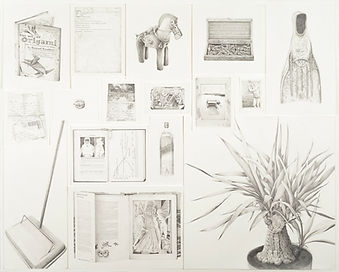


Fay Ballerd has created four memory boxes depicting objects she has drawn from life or memory — She drew her mother’s and father’s possessions, in order to have a spiritual connect between her parents. The collection was inspired by Ballerd cleaning out his childhood home after his father died in 2009. Every item in the home carries her memories and thoughts of previous events. Fay Ballard carefully examines and analyzes items found in her father's home after his death in April 2009. Ballard wanted to explore who she is and where she came from through her creation of memory boxes. Ballard has sparked many emotions because of the passing of his parents, and for many of us, this is a very sad time because life with our parents has turned into a past Ballard's work is a reflection on memory and loss.
Ballard recreated the items she found from drawings she placed in the cupboard and made a list of them. Her paintings are exquisitely detailed and at the same time very sensitive and powerful, making what seems inconsequential to Ballard and the viewer become very important and full of metaphors.
Here is an argument that highlights the idea of significance of the objects, in “The comfort of things” by Daniel Miller (Miller, 2009, p.2),The author raises a question, does the object speak? People have answered this question by decorating their homes. The author considers each item in the room to be a form in which people choose to express themselves. They put decorations in the living room and carpets in the living room. On the day of moving into a new home, people carefully select furniture. Some things may be gifts from others or they may be preserved from the past, people decide to live with them, and they keep them organized or cluttered; they make the room minimal or full of objects. These things are accumulated gradually and can also represent the profile of the person or the family. If one learns to observe and listen to these objects, one can learn a lot of hidden information from them.
I'm obviously not a minimalist, so I try to keep everything as close to my eyes as possible. I rarely use cabinets. I also like the feeling of being surrounded by many objects. Because I live alone, loneliness is always inevitable. For example, when I stay in a hotel. Although the hotel was convenient and fast, I knew I was not at home, so I lost sleep. Although my bed was not as comfortable as a hotel, and there was no staff to clean the room every day, I still felt my tiny room is the best place to relax. It's a strange psychological effect because of the lack of belonging.
A sense of belonging is one of the most important needs of people after ensuring basic food and safety. Psychologist Maslow believes that people must first solve their own food and clothing problems, and they need a safe and non-threatening environment. Based on these needs, people want love and belonging when their survival is guaranteed. According to Maslow's Hierarchy of Needs, if people ignore the sense of love and belonging, and jump to meet higher-level needs, and people cannot fill the emptiness and loneliness psychologically, the lack of belongingness can cause a lot of anxiety and even increase a person's risk of depression. When people come to an unfamiliar environment, the first thing they do is to actively build their sense of belonging. At this time, those items full of memory can quickly make a new place without memory become a little related to people. When the person is in a new environment, without family and friends, mementos that can trigger memories and become a great emotional sustenance (Maslow, 1983, pp.243-256).
Accumulations vs Collections (and holding):
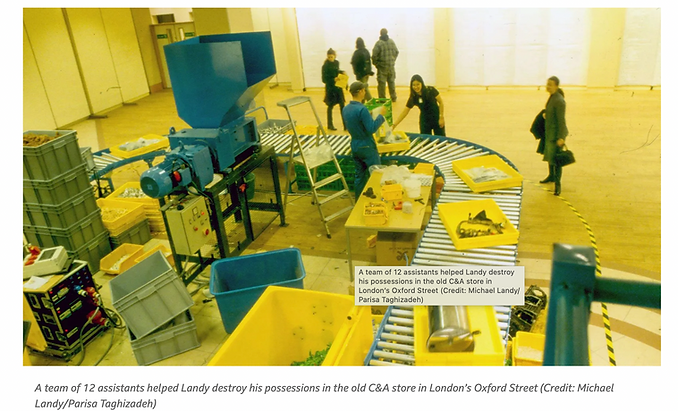
In 2001, a large-scale exhibition was held in a shop on Oxford Street in central London. This exhibition is unlike any other, and over the course of two weeks, everything the artist Micheal Landy owned—clothes, love letters, artwork, his car, his father’s sheepskin coat—was owned by Landy and his 12 assistants. The team strips, shreds, crushes, dismantles, or otherwise destroys, while music from David Bowie and Joyce is played. When they finished the show, Landy had nothing but the blue hoodie he had been wearing. He called the project "Break Down.”
In addition, Break Down project can be act as a contemporary memento: we all use possessions to varying degrees to construct our identities and project ourselves to others, yet in Landy's sense, these objects obscure human nature , he expressed his dissatisfaction with consumerism by destroying his possessions. This exhibition makes people feel depressed, and also triggers viewers to think deeply about the act of accumulating.
In a chapter of “Stuff” by Daniel Miller, the writer explained: “Clothing was a kind of pseudo-language that could tell us about who er are”. So material things are just an overlooked adjunct to the study of language: a form of communication that can be done through observation, which can actually express a lot of ideas once we get used to this ability. Undoubtedly, with the advent of this perspective, the study of material culture has intensified significantly. But in the end, it became a testament to people showing off their assets and a product of class division(Miller, 2010, p. 13).

In 2010, artist Song Dong shown his installation at Vancouver art gallery. Song Dong's “Waste Not” is an installation with a story. The art installation is based on what was left behind by the artist's mother, Xiangyuan Zhao. The device consists of tools, flower pots, chairs, empty toothpaste tubes, TV sets, packaging bags and many other things that people will not notice in everyday life. All of these have been collected by the artist's mother over the past 5 years. The artist expresses the accumulation caused by his mother's obsession with collecting those objects. At first glance, “Waste Not” looks like a cluttered room full of used items and junk. However, it has a powerful message about the changes that Chinese culture, memory, and society and politics have brought to people. Because of the cultural differences that time brings to people, many elderly people in China have the habit of "collecting" old things. Those old things don't refer to ordinary collectibles, but mostly are regarded as "junk" items. Like Song Dong's mother, my grandparents like to collect used cookie jars, used garbage bags. My grandfather even likes to go on the street to pick up abandoned flower pots and worn-out furniture. These items are all "useful", or "will be used someday". Because of their previous living habits, the development of the times gradually made their behavior incomprehensible. But looking back at history, in the years when they were growing up, collecting these things can truly saved the family from a lot of unnecessary costs.
John Elsner, in his book “Cultures of Collecting” analyzed: “If the peoples and the things of the world are the collected, and if the social categories into which they are assigned confirm the precious knowledge of culture handed down through generations, the our rulers sit atop a hierarchy of collectors. Empire is a collection of countries and of populations; a country is a collection of regions and peoples; each given people is a collection of individuals, divided into governed and governors- that is, collectables and collectors” (Elsner, 1994 p.10). From a social perspective of containment and regulation, a person's personal identity may be determined between personal collections and that of parents or anyone else. When one becomes aware of one's own existence, one becomes a conscious identity collector, collecting and projecting onto a body the various traits and personalities one desires to have. A collector's taste is a mirror of the self. However, taste is usually inherited, and what you may gather is just hereditary reflexes. Personal targeting is just one item people have in their social presence. Dreams are a product of people's attempts to resist social class and classification, which means people's attempts to break free from belonging to a particular group. Sometimes people collect in order not to succumb to social expectations or to find sustenance and belonging for their souls.

the magnificent obsessions: the artist as collectior exhibition
In February 2015, the magnificent obsessions: the artist as collector exhibition at the Barbican Museum brought together many items collected by different artists. It contains more than 8,000 private collections of well-known artists and the curator restores the original arrangement of these exhibits in each artist's residence as much as possible. Curator Lydia yee found that almost every artist has some collecting hobby. The contents of their collections rarely appear in their works but are closely related to their personal experiences and character preferences.
Most of the collector will collect a specific type of item. Which specify the idea of accumulation or collection.
“The fact is that the model is everywhere discernible in the series. It inhabits the slightest 'specific' difference between one object and the next. Above we noted the same tendency in collecting, where each item in a collection is marked by a relative difference which momentarily lends it a privileged status - the status, in effect, of a model; all such relative differences refer to all the others, and in aggregate they constitute absolute difference - or rather, fundamentally, just the idea of absolute difference, which is precisely what the Model is. We may say of a model that it exists or that it does not exist” (Baudrillard, 1996, p.144)

Since the age of four, James Brown has been interested in all kinds of vacuum cleaners. By the time he was eight years old he had a collection of vacuum cleaners of his own. As an adult, James chose to tie his career path to vacuuming. He owns a collection of 322 vacuum cleaners, holds the Guinness World Record for the number of vacuum cleaners, and also runs a shop and a vacuum cleaner museum.
The object as a form of portrait
Michael Randy said that "Breakdown" is also his own self-portrait, and the title even reflects the sense of crisis that the artist himself is experiencing as he grows older. He spent almost a year preparing lists of items for his exhibition and assigned catalog numbers to each of his items. Randy insisted that his exhibit must include "everything I owned – even bits of mouldy plastic that had fallen off the VCR”.
“Waste Not" is the pinnacle of Xiangyuan's hoarding. She uses the Chinese idiom “物尽其用”(use the best of everything) as a survival strategy in the 1970s, when most of Chinese people experienced chronic shortages and fears due to political and social unrest. Like the natural disasters she experienced as a child. In order to survive for themselves and their families, people started hoarding everything to prevent shortages. Another factor for Xiangyuan's hoarding is the unexpected death of her husband, which caused her to fall into great grief and depression. Hoarding things can keep Xiangyuan from feeling empty. “Waste Not” is a very clear portrait to show not only Xiangyuan, but also but someone at the same age with her.
Both Michael Landy and Song Dong’s work act as a form of portrait to himself/ family member. Viewers can easily discern their personal backgrounds, experiences, and preferences from the objects they own and exhibit. As curator Lydia Yee discovered, the items that everyone owns (collects) are tied to their personal experiences and characters. Its like a museum, each items reflects the story of an era.
Many times, people’s memory will be vague. They will also wonder about what makes them as right now. The memory function of human brain is limited, and as time passed by, people cannot completely remember the previous stories of their life. That's why a lot of old things are needed to help people recall their “footprints”. There are many things that people don't want to forget, but people can't control themselves to not forget. Because of the help of those objects, people can understand their own experiences and past more clearly, and they can also recall the scenes and stories at that time all.
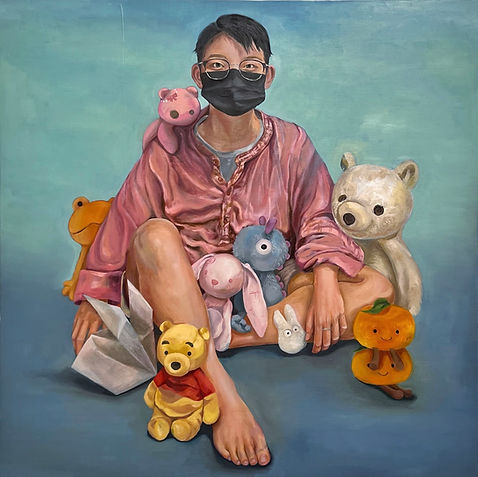
My painting “yaNoki”, is a portrait of a person surrounded with his collection of stuffed toys. During the time I interviewed with Yanki Hu (he/him), he explain his personal stories with his stuffed friends. Every single one was his favorite, and symbolize different time period of his life. He seen those toys as his friend, he chatted with them, named them, and sleep with them. “I know it sounds childish, but I greet them every time when I get back home and ask how’s their day is going. No matter where I travel, I always take my friends with me because I think they will miss me if they don't see me for a long time”, said by Yanki, "People are more likely to select someone or something that is similar to them, such as a companion compatible with their temperament and character or a pet that makes them feel more attractive. Therefore, soft toys are the equivalent thing to me. The reason why I have persistent requirements for their appearance, feeling, and facial expression is that they will accompany me in the future and bring me a sense of security. Their existence is like a part of me that has fallen out of my soul; thus, I will name them, take them on trips, and chat with them; sometimes, they will be the best comfort on my imperfect days". My work wants to express the importance of those objects to Yanki, and I want to show the happiness when Yanki around by the stuffed toy.
Most of the books that I read is associating with my unit 3 research are using real life examples to analysis the idea that the author willing to explain. It can connect to my practice, which I used the method of interviewing people in order to create artwork that related to their real life stories. Which I used the similar method in my unit 2 extended research. During the time I asking questions and looking at them, I can catch the emotion on their faces and really get into their personal stories.
Every object has a meaning for their existence. And people give things different meanings. Rather than saying that the item is important, the most precious thing is the memory that the item represents. Everyone’s experience is different, and the objects around them are different.